Dr. Nisha Ganesh

Nisha Ganesh, MD

Gastroenterology Fellow

University of Washington

About

I am a Gastroenterology Fellow at the University of Washington, where I am dedicated to advancing patient care through clinical excellence and research.

My clinical interests are in general gastroenterology, caring for patients across the full spectrum of digestive and liver conditions, from routine endoscopy to the long-term management of chronic disease.

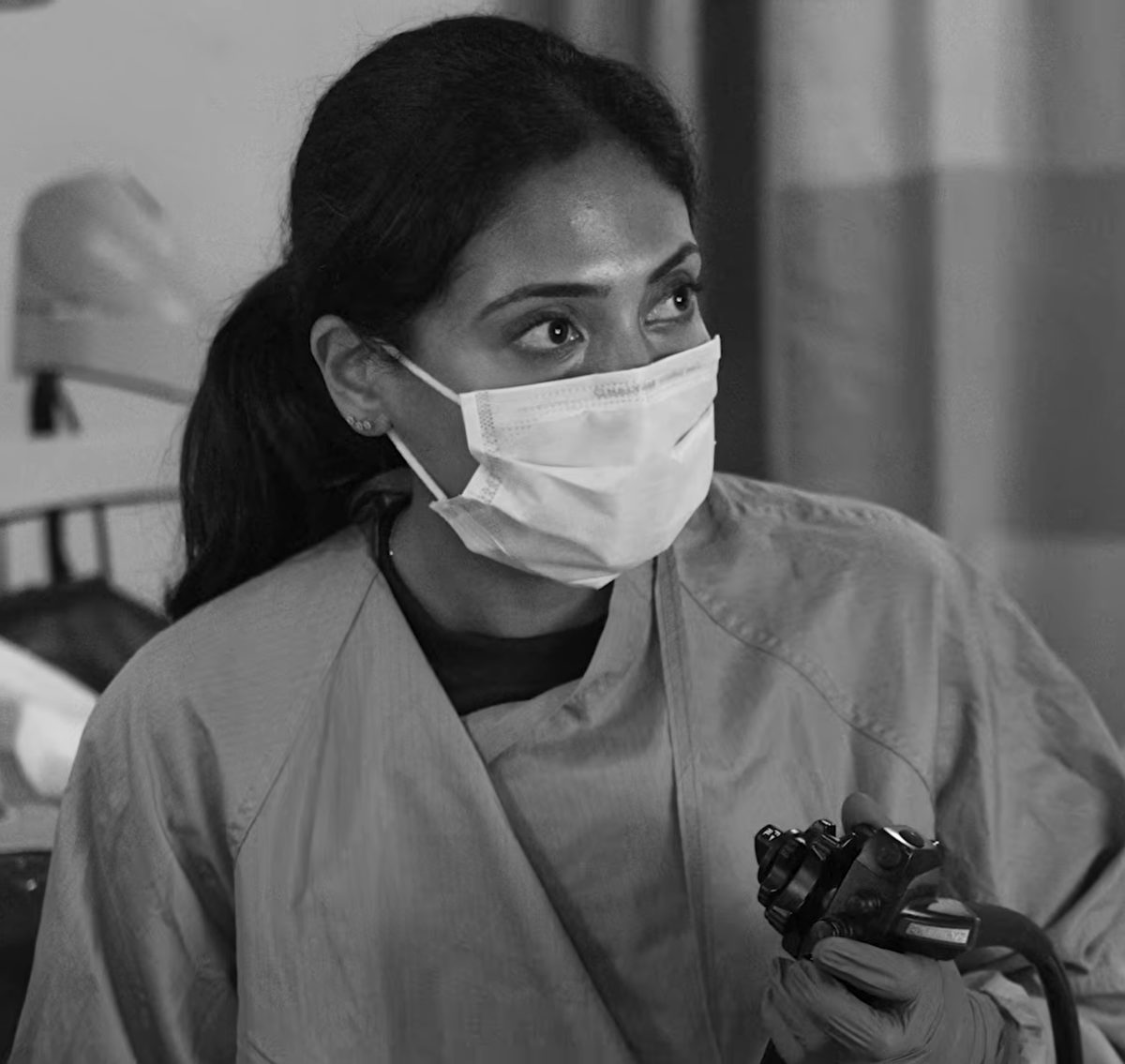
Dr. Nisha Ganesh performing an endoscopy

Selected Publications

Epigenetic Alterations in Colitis-Associated Colorectal Cancer

Epigenomes. 2026 Jan;10(1):4.

Nisha Ganesh, William M Grady, Andrew M Kaz

This review examines the epigenetic mechanisms driving colitis-associated colorectal cancer, a distinct subtype that arises from chronic inflammation in inflammatory bowel disease. We highlight the roles of aberrant DNA methylation, inflammation-induced histone modifications, and microRNA dysregulation in tumor initiation and progression, and discuss how these alterations may serve as biomarkers for earlier detection and intervention.

Diagnostic Accuracy of Timed Barium Esophagram for Achalasia

Gastroenterology. 2025 Jul;169(1):63-72.

Ofer Z Fass, John E Pandolfino, Jacob M Schauer, Nisha Ganesh, Domenico A Farina, Ayesha Lat, Eric Goudie, Linda C Kelahan, Dustin A Carlson

This study re-examined the diagnostic accuracy of timed barium esophagram (TBE) for achalasia using updated reference standards. We found that a classification tree model incorporating multiple metrics achieved 88.3% accuracy, significantly outperforming traditional single-metric methods, offering clinicians a standardized and more reliable approach to TBE interpretation.

The Importance of Predicting Patient Responses to Monoclonal Antibodies for Crohn's Disease

Expert Opinion on Biological Therapy. 2023 Jul-Dec;23(10):941-949.

Nisha Ganesh, Stephen B Hanauer, Parambir S Dulai

This review summarizes factors that predict responsiveness to biologic agents in Crohn's disease, including patient characteristics, disease phenotype, genetic markers, and gut microbiome composition. We discuss emerging clinical decision support tools powered by machine learning that may help clinicians optimize biologic selection for individual patients.

Contact

University of Washington Medical Center, Seattle, WA
My older brother is Abishek and he's a cool guy!